
|
AOK Computer Recycling
10944 Grissom #740
Dallas, TX 75229
AOK Administrative Office: 214.564.7795
AOK Warehouse: 214.616.6909
info@aokcomputerrecycling.com
Member TCEQ
Member National
Recycling Coalition
Member Recycling
Alliance of Texas
|
Legislation, Policy
& Government
What U.S. Government Legislation Has to Say About
Recycling
Information is one of the hottest commodities
in the world today prompting a growing concern for data security
and information privacy. In response a number of laws have been
passed in recent years; HIPPAA, GLB, and FIPPA. The Department of
Defense outlined procedures for secure destruction of hard drives.
Certain states are also increasing the stakes.
Today, old equipment is a major problem; companies
don’t want the expense and inconvenience of storing it but
probably don’t have the resources to dispose of the equipment
in an environmentally sound way … or to address possible liability
down the road. Outsourcing end stage asset management to AOK Computer
Recycling can serve as a solution.
Here are a few of the privacy and environmental
laws affecting US businesses;
California Computer & TV Recycling
Senate Bill 20- 2004, Requires companies to charge an upfront
fee for recycling. This legislation is being challenged on the grounds
that it does not advance the concept of producers’ responsibility.
However, it may serve as a precedent for further US State and Federal
legislation. ~ ISIS Asset Management, “The ICT sector: The
Management of Social and Environmental Issues in Supply and Disposal
Chains”, January, 2004.
Electronic Waste Recycling Act
- 2003, California enacted a landmark legislation act to establish
a funding system for the collection and recycling of certain electronic
wastes. The act requires reduction in hazardous substances used
in certain electronic products sold in California, collection of
an electronic waste recycling fee at the point of sale of certain
products, distribution of recovery and recycling payments to qualified
entities covering the cost of electronic waste collection and recycling,
and set forth a directive recommending environmentally preferred
purchasing criteria for state agency purchases of certain electronic
equipment.
California Senate Bill 1386-
2002, Required any company that stores information about California
residents to publicly divulge any breach of security affecting that
data within 48 hours.
Texas Hazardous Waste Regulations -
2000, States Industrial Solid Waste and Municipal Hazardous Waste
under state and federal regulations, television picture tubes and
computer monitors (cathode ray tubes, or CRT’s) can be managed
as Universal Wastes. Universal Wastes are still hazardous, and must
be recycled or disposed at authorized hazardous waste facilities,
but they are not subject to license and manifest requirements for
transport. Batteries may also be managed as Universal Wastes. Printed
circuit boards that are shredded and recycled are exempt from regulation
as solid waste. Read more at Title 30 of the Texas Administrative
Code (30 TAC) Chapter 335.
Gramm-Leach-Bliley Act (GLB)-
1999, Title V, in regards to privacy; requires disclosure of by
all financial institutions of their policy regarding the sharing
of non-public personal information; a notice to consumers and opportunity
to “opt-out” of sharing information; rules for disclosure
of institutions’ privacy policies must be issued by regulators
within 6 months of the date of enactments; clarifies that nothing
in this title modifies, limits or supersedes the operation of the
Fair Credit Reporting Act. GLB Act passes Senate and House November,
1999.
Health Insurance Portability and Accountability
Act (HIPAA)- 1996, Provides information protection for
working Americans who have preexisting medical conditions or who
might suffer discrimination in health coverage based on a factor
that relates to an individuals health; amends other Acts and Codes;
signed into law 1996.
Federal Hazardous and Solid Waste Amendment
(HSWA) - 1984 amendment to Resource Conservation and Recovery Act
Sec. 3010 or Subtitle C required phasing out land disposal of hazardous
waste; increased enforcement authority for EPA, more stringent hazardous
waste management standards, and a comprehensive underground storage
tank program.
Resource Conservation and Recovery Act
Sec. 3010 or Subtitle C- 1976
gave the EPA authority to control hazardous waste from “cradle-to-grave”;
includes generation, transportation, treatment, storage, and disposal
of hazardous waste. RCRA also sets forth a framework for the management
of non-hazardous wastes.
What About Global Legislation of Recycling of
E-waste?
Canada - Will have a comprehensive
electronic waste recovery system in place nation wide by 2006.
Energy Using Products (EUP)- European directive,
target implementation date July 1, 2006; defines and proposes policy
for Eco-Design, imposes recycled materials content on already marketed
products, addresses free movement of products so as to not reduce
competitiveness of businesses. The directive also takes into account
potential negative results of environmental measures; weighing overall
environmental impact of eliminating mercury from lamps versus substitute
material energy consumption.
Directive on Waste Electrical and Electronic
Equipment (WEEE)- 2002, European directive adopted in 2002;
sets minimum levels for recycling that must be met but may be exceeded,
imposes financial responsibility for recycling and final disposal
of electronic goods on producers, directive applicable to imported
goods. The directive also requires he substitution of various heavy
metals; lead, mercury, cadmium and hexavalent chromium, and brominated
flame retardants; polybrominated biphenyls (PBB) or polybrominated
diphenyl ethers (PBDE) in new electrical and electronic equipment
entering the market after July 1, 2006.
Restrictions of the use of certain Hazardous
Substances (RoHS)- 2002, European directive adopted in
2002; explicit directive outlines which substances should be restricted
and the precise levels that may be tolerated, lead free initiative,
addresses importers and exporters of electronic equipment as 1st
or secondary marketers; directive applicable to occupational sites.
This directive also standardizes electronic waste disposal across
EU member states.
Directive 2002/95/EC- 2002, European
directive approximates the laws of EU Member States on the restrictions
of the use of hazardous substances in electrical and electronic
equipment, contributing to the protection of human health and environmentally
sound recovery and disposal of e-waste.
(Manitoba) Freedom of Information and Protection of Privacy Act
(FIPAA)- 2000, Provides Manitobians and others with a right of access
to records of public bodies, subject to certain specified exceptions,
and with protection for personal information held by public bodies.
Also provides for independent review by the Manitoba Ombudsman of
the decisions and actions of public bodies relating to access to
records and personal information protection. Enforced at Manitoba
government departments May, 2001. Enforced at local governments,
school divisions, community colleges, universities, regional health
authorities and hospitals, April 2000.
Basel Convention - 1989, an international
convention adopted to ban export of hazardous waste to non-OECD
countries from EU countries. AOK chooses to comply with the Basel
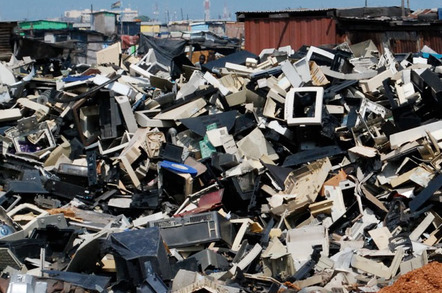
Convention; developing nations are often not equipped to handle
toxic waste produced from extracting metals in e-waste leaving communities
damaged by water and soil contamination.
|
| 
California Senate Bill 1386- 2002, Required
any company that stores information about California residents
to publicly divulge any breach of security affecting that
data within 48 hours.
Canada - Will have a comprehensive electronic
waste recovery system in place nation wide by 2006.
Basel Convention- 1989, an international
convention adopted to ban export of hazardous waste to non-OECD
countries from EU countries. AOK chooses to comply with the
Basel Convention; developing nations are often not equipped
to handle toxic waste produced from extracting metals in e-waste
leaving communities damaged by water and soil contamination.
Federal Hazardous and Solid Waste Amendment
(HSWA) - 1984 amendment to Resource Conservation and Recovery
Act Sec. 3010 or Subtitle C required phasing out land disposal
of hazardous waste; increased enforcement authority for EPA,
more stringent hazardous waste management standards, and a
comprehensive underground storage tank program.
|
|